
Do the Math Before You Do the Drawing: How High-Performance Warehouse Layouts Are Born
Issue #007 – April 15, 2026
In This Issue (tl;dr):
A great warehouse layout isn’t born from a sketch. It’s born from analysis. First, analyze the data. Then define the planning parameters. Then size the major functional areas. Then arrange those areas around optimized relationships and flows. Only after that should you draw the detailed layout. Warehouse layout, in other words, is a numbers game—not a guessing game.
Psst, don't miss the bonus quarterly contest winner announcement at the end of this post.
(Especially if your name is Sophia Michael.)
A client once showed us a sketch of their new warehouse layout.
At first glance, it looked reasonable. The main warehouse functions were there. It looked like they knew what they were doing.
Unfortunately, they didn’t.
They developed that sketch before really crunching the numbers. No formal planning parameters had been defined. The major functional areas hadn’t been sized based on the right computations. The material flows hadn’t been rationalized.
In other words, their drawing showed confidence, but it was built on shaky assumptions instead of meaningful analysis.
Once we did the math, reality came into focus. The client’s layout would have resulted in an average distance of 206 feet between main functional areas. By comparison, our layout brought that distance down to 152 feet.
That means their version would have required about 35% more travel, just to get the same work done.
That’s not a rounding error—it’s a lot of extra walking and driving. Unnecessary labor and time.
As Inviscid Man might say after rescuing yet another project from premature sketching: “The cape is optional. The math is not.”
John Wooden said it even better: “If you don’t have time to do it right, when will you have time to do it over?”
That advice applies to warehouse planning just as much as it applies to basketball.
Don't Ask the Magic 8-Ball
If warehouse layout could be done with the help of a Magic 8-Ball, life would certainly be easier. But would that be effective?
You: “Is this layout efficient for our business?”
Magic 8-Ball: “Reply hazy. Ask again later.”
Fun? yes. Effective? No.
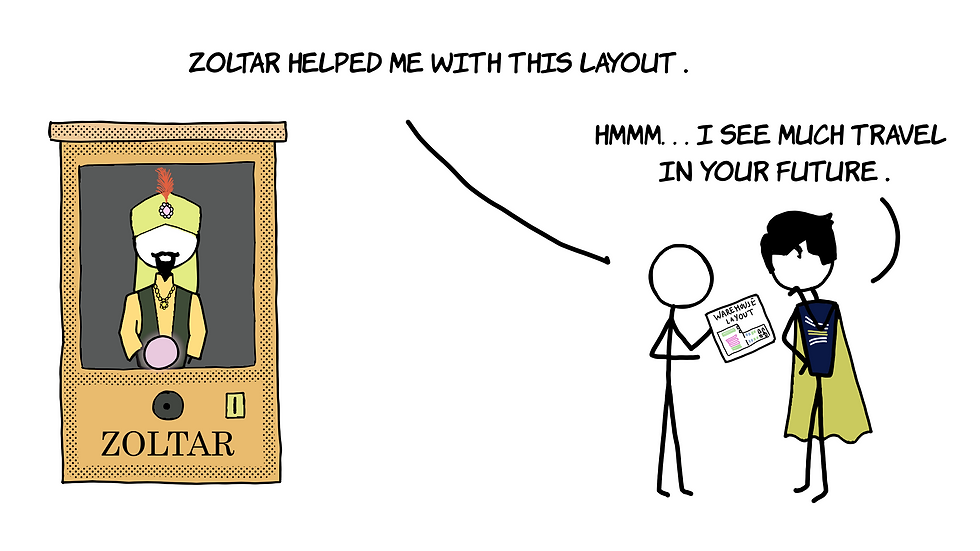
And for the record, I also wouldn’t recommend a quick visit to the amazing Zoltar, or any other fortune teller.
No. A good layout is engineered, not guessed.
Guessing comes with built-in waste that has a nasty habit of showing up every day as lower productivity, higher labor costs, and slower processing.
The Devil Is in the Details
That’s what they say. And the devil in these details can make or break a warehouse.
The details point to the right handling, storage, and processing methods. And those methods determine equipment needs and labor needs, which ultimately govern the size of each functional area.
It’s an iterative process, and this is where many layout efforts quietly go off the rails.
Naïve but well-intentioned people often start by guessing—rushing to sketch their layout before they really even understand their numbers. (And you know what’s paved with good intentions.)
Don’t do it.
Do the Math First
That means starting by analyzing and defining the planning parameters. These are the detailed requirements the warehouse must satisfy to support its mission for the business.
Not a SWAG. Not “gut feel.” And definitely not the highly scientific method of drawing some boxes on paper and saying, “Yeah, that layout looks like it would work.”
Planning parameters include statistics like:
SKU counts
Inventory levels
Volumes (orders, lines, units, etc.)
Unit-of-measure mix
That last statistic matters a lot. Are you handling pallets? Cases? Inner packs? Eaches? Some magical combination of these? Pallets, cases, inner packs, and eaches might belong to the same warehouse family, but they don’t all prefer the same living arrangements.
And last year’s numbers are old news. The planning parameters should reflect the warehouse’s requirements over its entire planning horizon. That means projected growth and other changes to the business must be factored into it.
Garbage In is Garbage Out
Good recipes depend on the right blend of good ingredients, right? (Try making your grandmother’s famous spaghetti sauce with bad tomatoes and too much salt.)
If the data inputs are outdated, incomplete, overly optimistic, or just plain wrong, then the resulting layout will be flawed.
Sure, the drawing might still look good. It might even impress eager people in the ivory-tower conference room.
But it’s just lipstick on a pig.
Done right, your planning parameters aren’t bureaucratic paperwork. They’re your recipe for success.
Size the Blocks Before You Play Tetris
After your planning parameters are defined, the next step is sizing the major functional areas.
This is where the operation stops being a concept and starts morphing into actual space requirements.
That means determining the necessary sizes of areas like:
Receiving
Reserve storage
Forward picking
VAS
Packing
Consolidation
Staging
Shipping
Returns
Parking and battery charging for lift trucks and pallet jacks
Offices and support areas
Those answers shouldn’t come from optimism. Or a Magic 8-Ball. Or Zoltar.
They should come from the iterative process that began with your planning parameters.
Peak inventory levels drive storage requirements. Peak volumes drive picking, packing, and shipping requirements. Unit-of-measure mix affects not just how much space is needed, but what kind is needed.
Square footage matters. But cubic footage matters too. Sometimes the smarter answer is to go up, not out. Of course, that might require different types of storage and handling equipment, so there are always trade-offs.
A warehouse can be the right overall size and still be badly planned if its internal areas are out of balance.
Too little forward-picking space can create constant replenishment headaches. Too little staging can choke outbound flow.
And too much space of any type just kills productivity and wastes money. It’s just a roomier version of being wrong.

Put Friends Near Friends
After the functional areas are sized, the next question isn’t, “How do we cram these together?” It’s, “What should be near what?”
Now comes the Tetris part. Activity relationships and material flows enter the picture.
This is the step where a bunch of correctly sized boxes either become an efficient operation or a costly obstacle course.
Some functional areas belong close together. Some don’t.
Here’s the truth: functional areas are a lot like people. They want to be near the folks they like and far from the ones who drive them nuts.
Receiving wants a close relationship with reserve storage. Forward picking likes hanging out with packing and shipping. Offices and break rooms, meanwhile, hate to be near noise from conveyors and forklift horns.
Layouts scream inefficiency when things like these happen:
Related areas are too far apart.
Travel paths are long, zig-zag, cross, or double back.
People and equipment interfere with each other.
Inbound and outbound activities compete for the same space.
That’s when Inviscid Man would lean forward and whisper, “I see much travel in your future.”
It’s better to learn that through sensible analysis than from mistakes. Or fortune tellers.
The goal is not just to make the layout fit in the building. The goal is to arrange the major functional areas so movement of people and product between highly dependent areas is minimized.
And those paths should look more like arrows than overcooked spaghetti.
Details Come Last
The detailed layout shouldn’t be developed until due-diligence is complete.
That’s when you get into rack, shelving, traffic aisles, work aisles, docks, workstations, offices, parking and battery charging, and the rest of the physical details that make a warehouse look like a warehouse.
Those things matter, but they matter last.
If you jump into detailed layout too soon, you lock in assumptions that might not even be right. You start drawing rack rows before you even know whether the storage area is the right size. You start placing workstations before you’ve reduced the work to be done.
In plain English, you put the cart before the horse. (And horses hate to push carts.)
The Bottom Line
A high-performance warehouse layout doesn’t begin with a sketch.
It begins with numbers. Lots of numbers.
So, do the work in this order:
Analyze the data.
Define the requirements.
Size the functional areas.
Arrange those areas based on relationships and flows.
Develop an efficient block layout.
Then draw the detailed layout.
Skip any of these steps or do them backward, and you might end up with a pretty drawing. But a pretty mistake is still a mistake.
Do those things right, and the payoff can be enormous:
Lower labor costs
Faster processing
Better use of space
More flexibility
Fewer expensive surprises later
If you'd like help developing a high-performance layout like that, let us know.
Until our next episode...thanks again for joining us! And keep an eye out for Inviscid Man in a warehouse or DC near you.

Stephen T. Hopper, P.E.
Founder & Principal
Click “Subscribe” below if you want these insights delivered straight to your inbox. We promise we’ll only send valuable content. But we won’t spam you. Ever.
Saving the World, One Warehouse at a Time™

We’re Not Predicting Inflation. You Are.
Quarterly bonus Winner.
Congratulations, Sophia Michael!
Your prediction of the US Consumer Price Index (CPI) for 2026 was accurate (2.7% so far) for January through March, so you're our winner of this quarter's $25 Amazon gift card. Details will be sent to the email address used for your contest submission. Enjoy!
Brianna Jeane, James Miller, and Mason Thompson, who also guessed 2.7%, are our runners-up since Sopia's entry came in first.
Stay tuned to see who will win the next prize, for January through June!


Comments